
Question #293

Can a bin know what was put in it?

Private Research Prototype

Built by Quinn Labs to explore future opportunities. Not a proposal. A conversation starter.

Prepared exclusively for KopaDot.

What could KopaDot become by 2031?

Rather than reviewing your current systems, Quinn Labs explored where future competitive advantages may exist. Everything below is an experiment. Nothing is assumed.

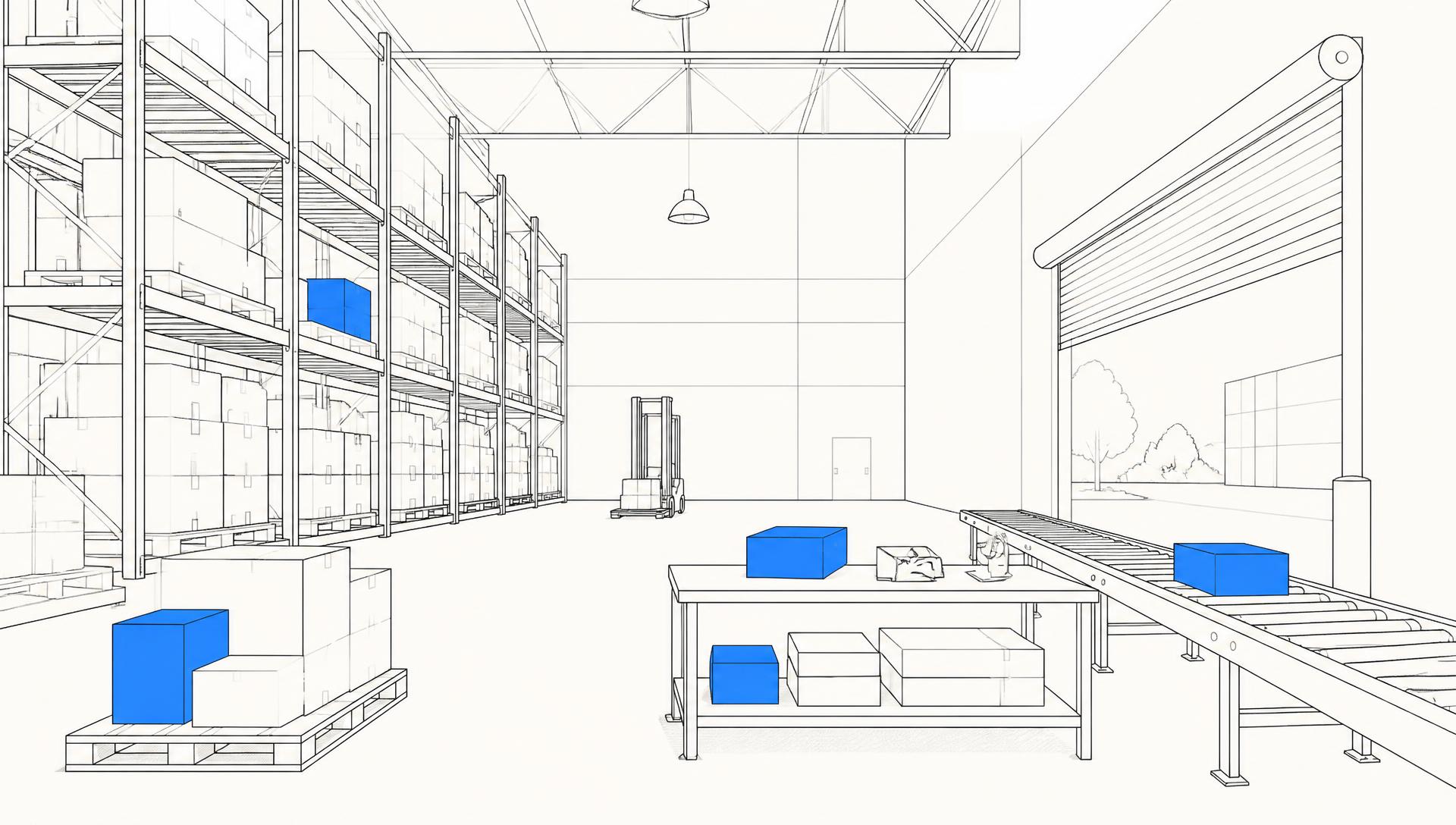
Line illustration of a warehouse with racking, a packing bench and a conveyor

Today

  1. Products
  2. Warehouse
  3. Packaging
  4. Courier
  5. Customer
  6. Returns
  7. Support

2031

  1. Connected intelligence
  2. Packaging learning
  3. Warehouse learning
  4. Customer preparation
  5. Returns memory
  6. Material passports
  7. Continuous improvement

The questions

Not solutions. Questions.

Q01

Can every parcel teach the warehouse?

Q02

Can every return improve future packing?

Q03

Can packaging explain itself?

Q04

Can dispatch quietly optimise itself?

Q05

Can customers prepare before deliveries arrive?

Q06

Can products have digital passports?

Reality Experiments

Six directions worth exploring

01 · Packaging intelligence

Can every parcel automatically recommend the safest, cheapest and most efficient packaging?

Why this matters

Packaging sits between the product and the customer. It decides damage rates, courier cost, packing time and how much material leaves the building.

Current observation

Packaging decisions are often based on experience and standard operating procedures rather than the record of what happened last time.

Research direction

Explore whether operational data could recommend packaging choices based on product dimensions, damage history and courier requirements.

Potential value

Reduced material useLower shipping costsReduced damageFaster packing

Questions for discussion

  • How are packaging decisions currently made?
  • Where does damage occur?
  • Which products are hardest to pack?

02 · Warehouse learning

Can every day make tomorrow's warehouse more efficient?

Why this matters

A warehouse produces evidence all day and mostly discards it. Walking distances, picking mistakes, damage patterns, seasonality and packing times are all recorded somewhere and read by nobody.

Current observation

Improvement currently arrives as reports, after the fact, describing a week that has already gone.

Research direction

Instead of reports, the warehouse quietly learns. Patterns surface as small suggestions at the point they matter, with no criticism attached to anyone.

Potential value

Shorter picking routesFewer repeat mistakesPredictable seasonal peaksContinuous improvement

Questions for discussion

  • Which tasks take longer than they should?
  • Where do mistakes cluster?
  • What changes between quiet and peak weeks?

03 · Returns memory

What if returns became the warehouse's best teacher?

Why this matters

A return is the most detailed feedback a business ever receives, and it usually ends as a restocking task.

Current observation

Return reasons are captured as categories, not as patterns that reach the people packing the next one.

Research direction

Capture why products return, identify the patterns, and feed them back into packing, product information and listings.

Potential value

Fewer avoidable returnsBetter product informationImproved packingLower handling cost

Questions for discussion

  • What are the three most common return reasons?
  • Which products return most, and why?
  • How much of a return is avoidable?

04 · Customer preparation

Can delivery begin before the parcel arrives?

Why this matters

Most delivery failures and bad first impressions happen in the customer's hallway, not in transit.

Current observation

The current message is 'your parcel is arriving', which tells the customer nothing they can act on.

Research direction

Explore whether a delivery can prepare the person receiving it: clear 2m², estimated assembly fifteen minutes, two people recommended, packaging recycling guidance, installation help if wanted.

Potential value

Fewer failed deliveriesFewer support callsBetter first impressionFewer damage claims

Questions for discussion

  • Which products cause the most arrival problems?
  • What do customers call about in the first hour?
  • Which deliveries genuinely need two people?

05 · Product passport

Can every product carry a digital companion for its whole life?

Why this matters

Everything a customer needs after purchase is scattered across PDFs, emails, listings and memory.

Current observation

Support answers the same questions repeatedly because the product itself carries none of its own information.

Research direction

Every product receives a digital companion holding assembly, warranty, care, materials, recycling, replacement parts, videos, common questions and compatible accessories.

Potential value

Lower support loadLonger product lifeSpare part revenueRecycling clarity

Questions for discussion

  • Which products generate the most questions?
  • Where do spare parts currently get lost?
  • What happens to a product after five years?

06 · Future packaging

Can some products eliminate disposable shipping packaging altogether?

Why this matters

The cheapest packaging is the packaging that is never made, but only some products can survive without it.

Current observation

Reusable and packaging-free shipping usually fails on return logistics and damage risk rather than on intent.

Research direction

Research only. Identify which product categories could travel protected by their own form, a reusable carrier, or the courier network itself.

Potential value

Material reductionLower cost per shipmentDifferentiationRegulatory readiness

Questions for discussion

  • Which products are already robust in transit?
  • Would customers return a reusable carrier?
  • What does packaging currently cost per order?

Where reductions could appear

Packaging
Damage
Returns
Transport
Materials

Shown as operational outcomes first. The environmental benefit is a consequence, not a claim.

The Quinn Labs method

QuestionResearchPrototypePilotDecisionProduct

The goal wasn't to redesign KopaDot.

It was to explore what the next decade might make possible.

The strongest ideas rarely begin as specifications. They begin as questions.

Thank you for allowing Quinn Labs to imagine alongside you.

We didn't build this because we think your business needs fixing. We built it because every successful business eventually reaches a point where asking bigger questions matters more than making smaller improvements.

About Vision Prototypes